Converting Salts into Acids and Bases
Converts waste and by-product salts into acids and bases for reuse in the process.
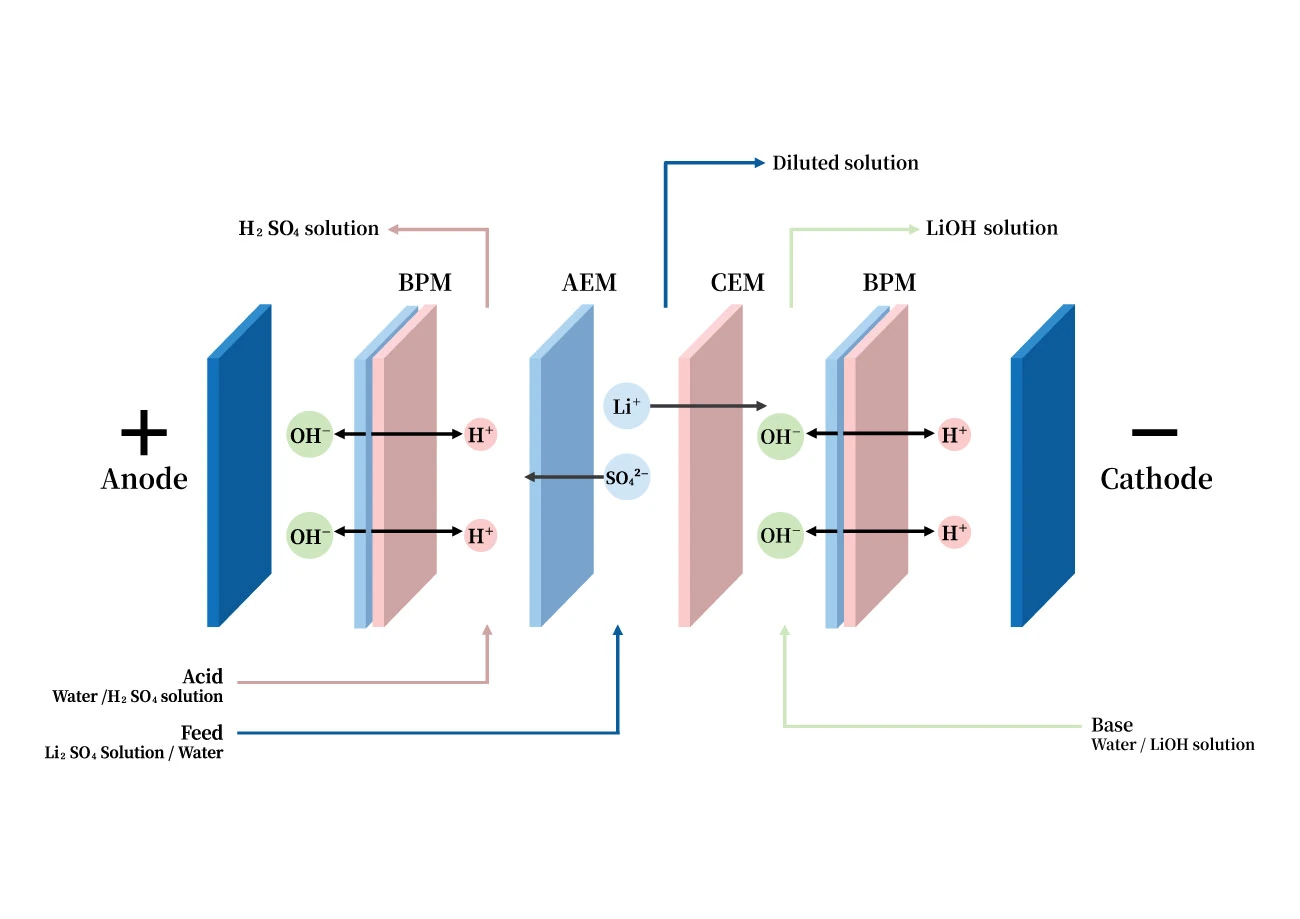
BPED is an ion-exchange membrane process that uses bipolar and ion-exchange membranes to convert salts into acids and bases.
A bipolar membrane combines a cation-exchange layer (CEL) and an anion-exchange layer (AEL). An applied electric field dissociates water (H₂O) into hydrogen ions (H⁺) and hydroxide ions (OH⁻) at the interface.
The H⁺ and OH⁻ combine with anions and cations transferred from the feed salt to form acids and bases. The generalized reaction is MX + H₂O → HX + MOH (M⁺: cation, X⁻: anion).
For example, sodium sulfate (Na₂SO₄) can be converted into sulfuric acid (H₂SO₄) and sodium hydroxide (NaOH), depending on process configuration and operating conditions.
BPED therefore transforms waste salts into reusable acid and base resources.
Converts waste and by-product salts into acids and bases for reuse in the process.
Water dissociation in bipolar membranes can reduce the amount of externally supplied acid and alkali required by a process.
Recovers useful chemical feedstocks from inorganic or by-product salts that would otherwise be discarded.
Ion separation, migration, and acid and base production take place within one ion-exchange membrane system.
The acids and bases produced can be reused in pretreatment, pH control, cleaning and manufacturing through closed-loop process configurations.