Salt Composition Conversion
Produces new salts by recombining cations and anions from different salts.
EDM is an ion-exchange membrane process that electrically separates the cations and anions of two different salts and recombines them into new salts.
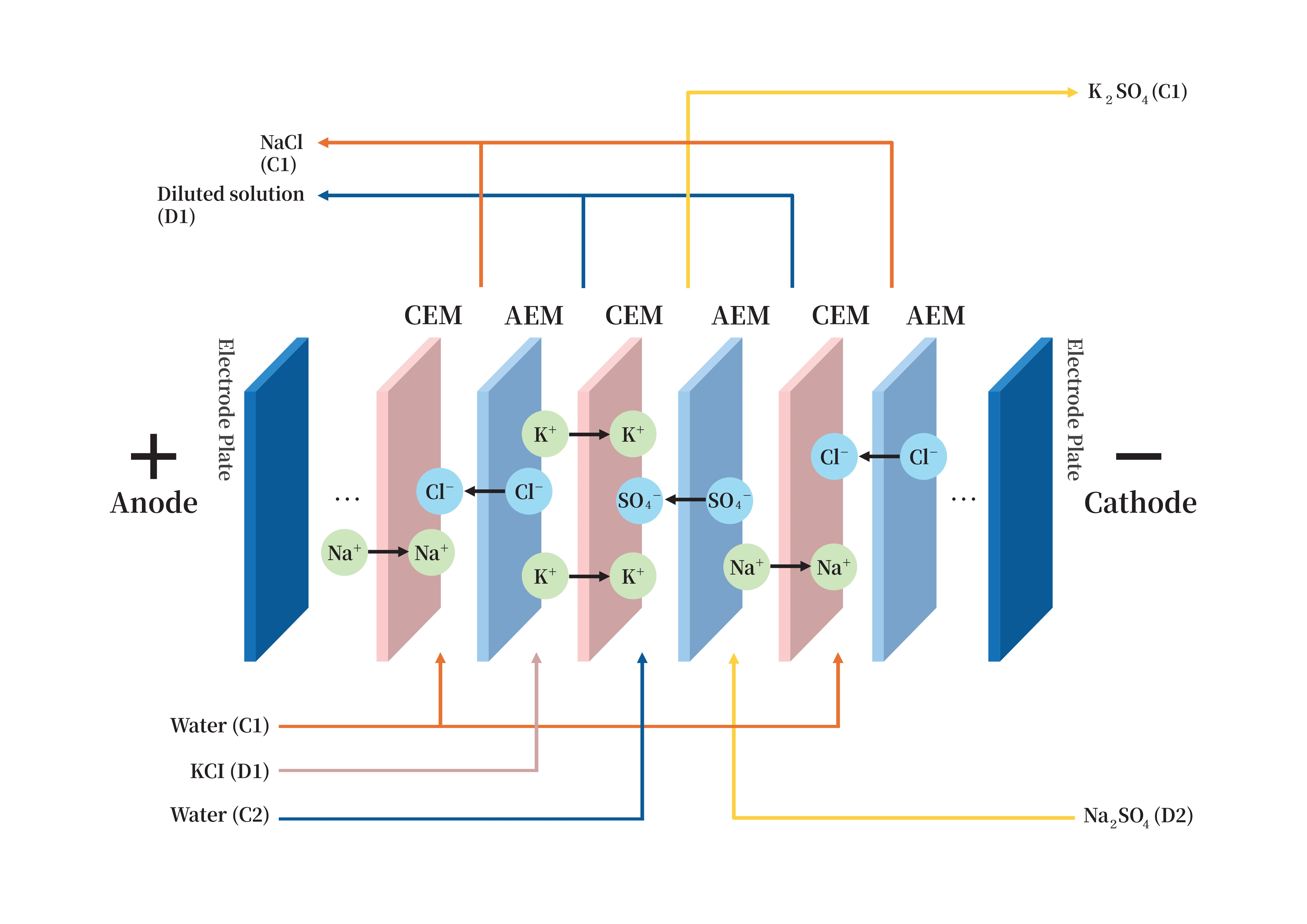
A typical EDM stack uses cation-exchange membranes (CEMs) and anion-exchange membranes (AEMs) to form a repeating four-compartment structure with two feed channels and two product channels.
Under a DC electric field, cations and anions from each feed solution selectively pass through ion-exchange membranes and combine with different ions in adjacent product channels to form new salts.
In generalized form, the ion combinations of two salts can be changed according to MX + NY → MY + NX.
For example, sodium sulfate (Na₂SO₄) and potassium chloride (KCl) can be converted into potassium sulfate (K₂SO₄) and sodium chloride (NaCl), depending on operating conditions.
Beyond desalination and concentration, EDM enables targeted changes in salt composition while concentrating the products.
Produces new salts by recombining cations and anions from different salts.
Ion-exchange reactions and product concentration occur in a single membrane process.
Suitable substitution salts can convert sparingly soluble salts into more soluble forms, helping reduce scaling risk during subsequent concentration.
Feed salts, substitution salts and membrane arrangements can be selected to achieve the desired product salt composition.
Converts salts in industrial by-products and high-salinity wastewater into useful salt products or process feedstocks.