Simultaneous Desalination and Concentration
Produces diluate and concentrate streams in a single process.
ED is an ion-exchange membrane process that uses a DC electric field to selectively separate and concentrate ions in aqueous solutions.
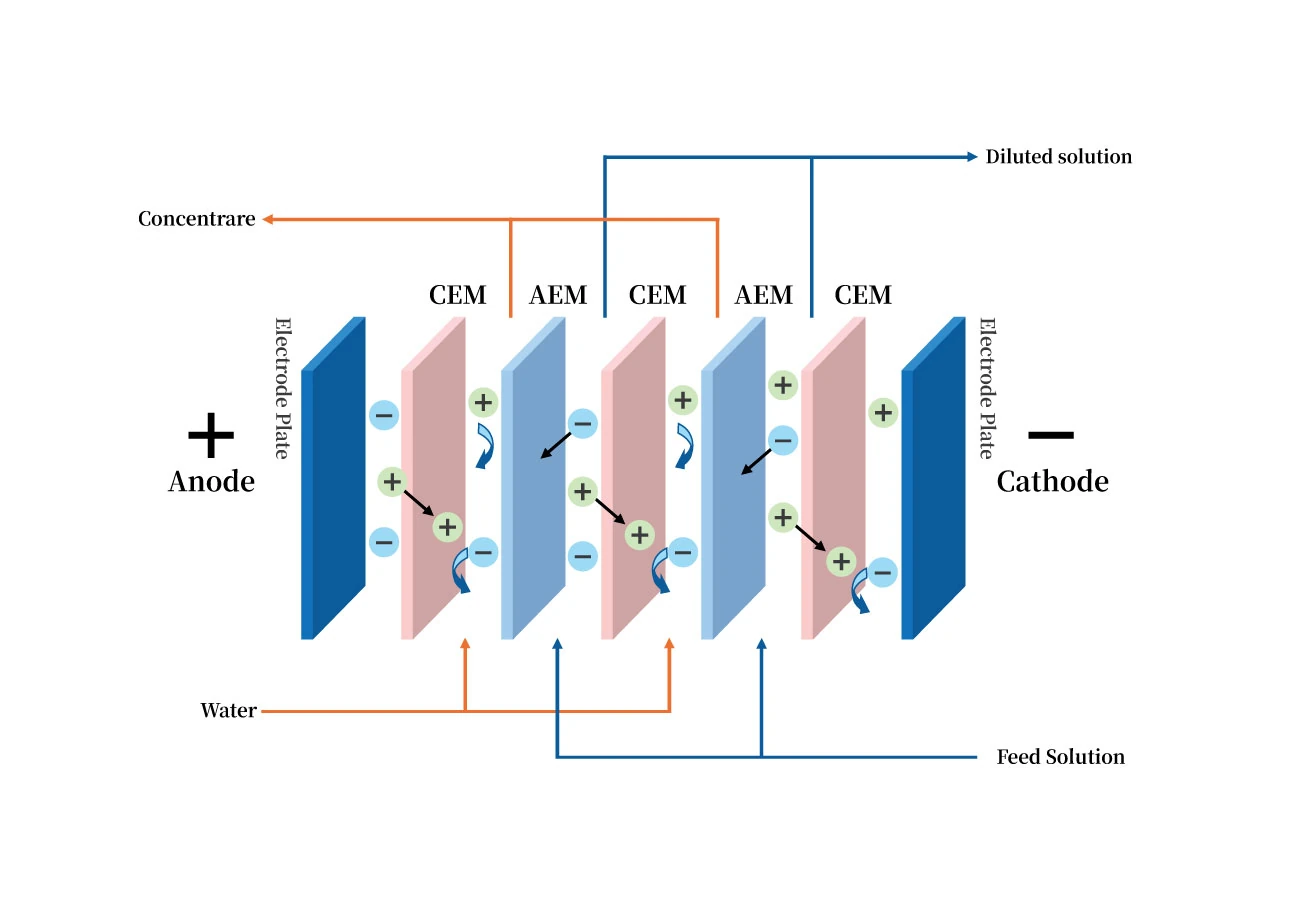
Cation-exchange membranes (CEMs) and anion-exchange membranes (AEMs) are arranged alternately. Under an applied electric field, cations move toward the cathode (−) and anions toward the anode (+).
Cations selectively pass through CEMs and are restricted by AEMs, while anions pass through AEMs and are restricted by CEMs.
This selective ion migration creates diluate chambers with reduced ion concentrations and concentrate chambers where ions accumulate.
The process enables simultaneous desalination and concentration. Depending on operating conditions and membrane characteristics, selective separation and recovery of specific ions are also possible.
Produces diluate and concentrate streams in a single process.
Ion migration does not require separate acid or alkali regeneration, helping reduce chemical consumption.
Ion-exchange membrane properties enable selective transfer of ionic substances. Selective membranes can enhance separation of specific groups of ions.
An electric field rather than a pressure difference drives the process, allowing flexible application to industrial wastewater and concentrated brines.
Voltage, current density, flow and the number of stages can be adjusted to control treated water quality and concentration.