Low-Temperature Waste Heat Utilization
Operates with relatively low-temperature heat sources and can integrate industrial waste heat, low-pressure steam, hot water and other low-grade heat.
Membrane distillation (MD) is a thermally driven separation process that uses a hydrophobic microporous membrane.
Water evaporates on the hot feed side, passes through the membrane pores as vapor, and condenses on the colder side. Non-volatile substances, including salts and minerals, remain in the feed.
Because only water vapor passes through the membrane, MD can produce very high-purity water regardless of feed salinity.
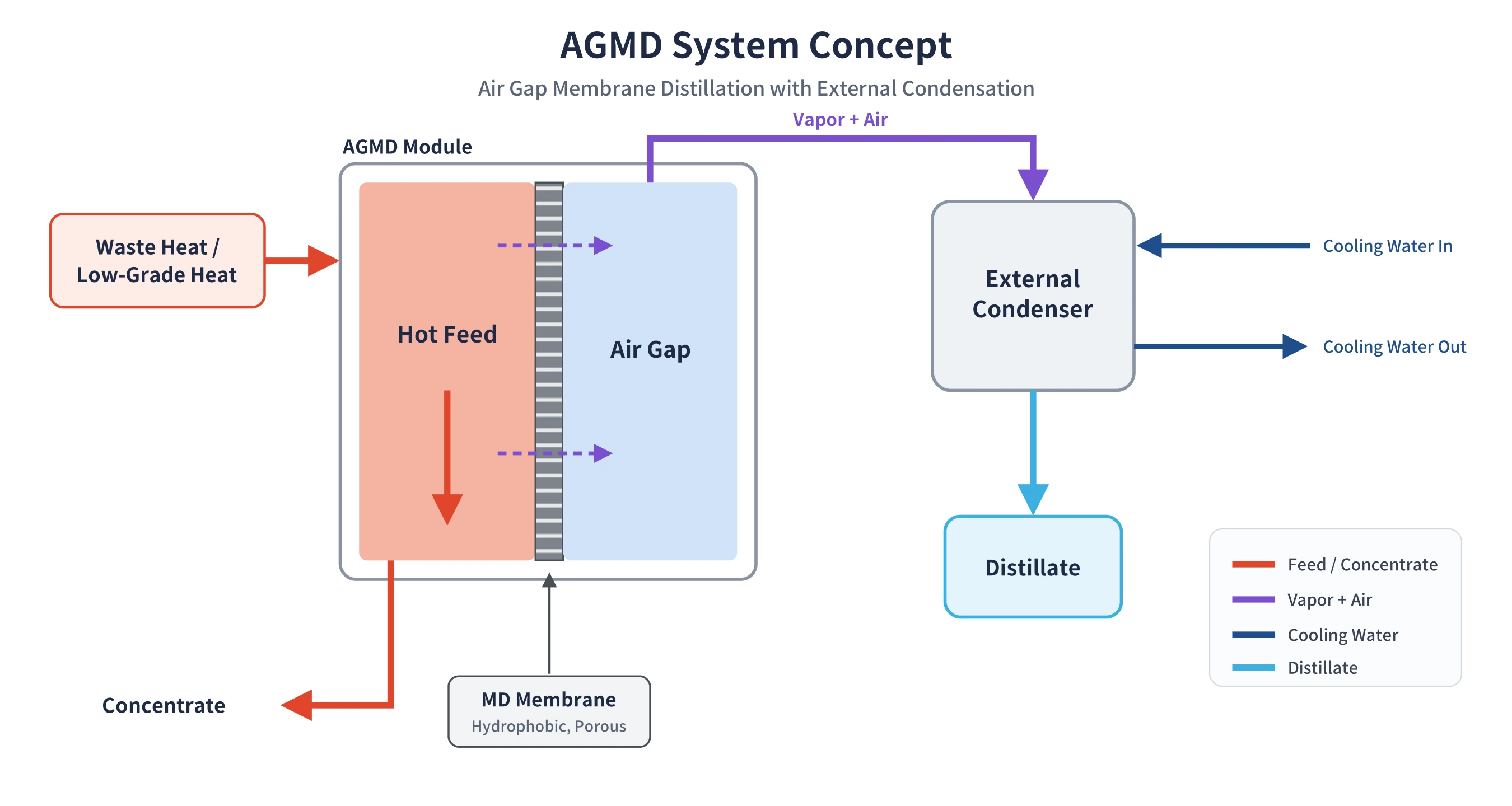
Innoflow Technologies is developing an AGMD system that combines waste heat utilization, vacuum-assisted vapor transfer and external condensation with an established AGMD configuration.
The condensation function is moved outside the conventional AGMD module. Water vapor passing through the membrane and air in the air gap are drawn into an external condenser under reduced pressure.
The external condenser condenses the vapor to recover product water. The dried and cooled air can then be recirculated to the air gap.
This separates the membrane stack and condensation system functionally, simplifying the stack and enabling external heat recovery and thermal optimization.
Industrial waste heat or a low-temperature heat source heats the feed.

The vapor pressure difference between the heated feed and the permeate side causes water to evaporate at the membrane surface.
The vapor passes through the hydrophobic membrane pores, while salts and most non-volatile substances remain in the feed.
Controlled vacuum in the air gap reduces mass-transfer resistance from non-condensable gases and transfers vapor to the external condenser.
The vapor is cooled and condensed outside the stack, recovering high-purity product water.
Condensation heat can be recovered for feed preheating. Depending on system configuration, cooled air can be recirculated to the air gap.
Operates with relatively low-temperature heat sources and can integrate industrial waste heat, low-pressure steam, hot water and other low-grade heat.
The vapor pressure difference drives the process without the direct osmotic-pressure limitations of pressure-driven membrane processes, enabling treatment of high-salinity brines and industrial wastewater.
Under normal operating conditions without membrane wetting, the process can achieve very high rejection of salts and most non-volatile substances.
Controlling non-condensable gases in the air gap reduces air-gap mass-transfer resistance, a major resistance in conventional AGMD.
External condensation allows condenser capacity, cooling conditions and operating conditions to be optimized independently.
Latent heat recovered during external condensation can be reused for feed heating, facilitating integration with heat pumps and heat recovery systems.
A modular membrane stack and external condenser configuration can be expanded to match treatment capacity.